

[ad_1]
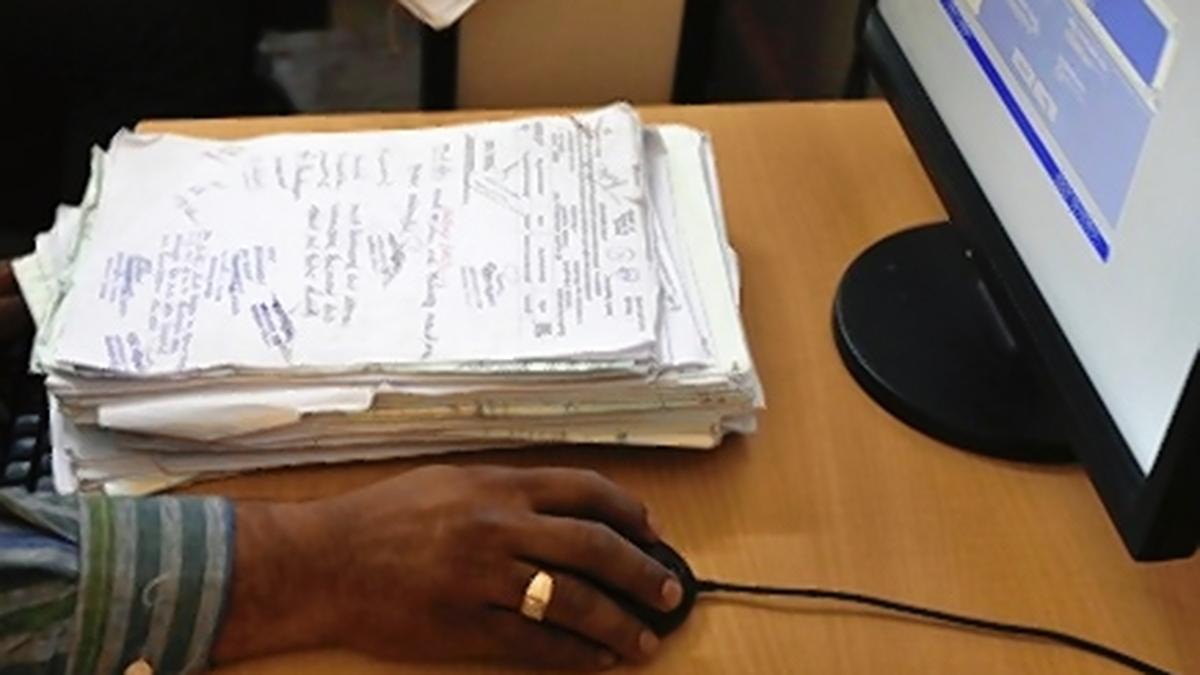
Picture for the aim of illustration solely.
| Photograph Credit score: Aijaz Rahi
GUWAHATI
The Bodoland Territorial Area (BTR) in Assam has turn out to be the primary tribal council beneath the Sixth Schedule of the Structure to completely digitise its land information.
Officers mentioned the digitisation of greater than 15 lakh land paperwork, together with texts and maps, throughout the 8,970 sq. km BTR was accomplished just a few weeks in the past, ending a long time of handbook record-keeping.
There are 10 tribal councils beneath the Sixth Schedule within the north-east – three every in Assam, Meghalaya, and Mizoram, and one in Tripura. Two of Assam’s councils, in Karbi Anglong-West Karbi Anglong and Dima Hasao, have been arrange 5 a long time earlier than the Bodoland Territorial Council (BTC) was constituted in 2003.
The BTC administers the BTR comprising 5 districts in northern and western Assam.
The Sixth Schedule comprises particular provisions for the administration of tribal areas, empowering autonomous councils to handle land, forest, and native governance inside their jurisdictions. Nevertheless, these councils have usually confronted useful resource constraints, infrastructural gaps, and administrative hurdles.
Officers mentioned the BTR authorities’s adoption of technology-driven governance, together with the e-office system, has demonstrated how such challenges could be addressed according to the Digital India Mission.
BTC Secretary Dhiraj Saud mentioned the digitisation course of started in 2023 to reinforce transparency in land possession and simplify customary landholding patterns.
“The train concerned ground-level surveys throughout all subdivisions of Baksa, Chirang, Kokrajhar, Tamulpur, and Udalguri districts. Outdated land information, some courting again a number of a long time, have been digitised and cross-verified with income information and maps,” he mentioned.
Officers mentioned Geographic Info System (GIS) mapping was built-in to make sure accuracy in land boundaries.
The train additionally helped streamline the Pramod Boro-led BTR authorities’s Mission Bwismwuthi 2.0 earlier this 12 months, beneath which land rights have been supplied to 47,000 indigenous landless households, together with 9,000 small tea growers and rubber farmers. Within the first part of Mission Bwismwuthi, which affords 14 land-related providers, greater than 2.11 lakh functions have been disposed of.
Officers mentioned the brand new digital platform now permits farmers, landowners, and residents to examine land standing by kiosks, cell functions, and net portals.
“Land disputes have usually been the reason for social rigidity in our space. By digitising information, we’re guaranteeing transparency and minimising probabilities of corruption, forgery, and battle,” a Income Division official mentioned.
They added that the BTR’s land document digitisation and e-office system have turn out to be a case examine for different autonomous councils within the north-east.
Printed – September 03, 2025 04:37 pm IST
Source link

